
Across multiple sectors, organisations are experiencing more coordinated and externally supported forms of workplace representation and dispute management. Issues escalate faster, involve more moving parts and are increasingly campaign-driven.
Based around the idea of leverage and the organising works model that was imported from the US, and adopted wholesale by many unions and the TUC, at the turn of the centry, dispute escalation and resolution has evolved from traditional negotiating tactics.
With the Employment Rights Act (ERA) set to reshape access, recognition and information rights from 2026, these trends are converging — and putting real pressure on HR, ER and leadership teams to build new levels of capability. Many of whom haven’t been in the room when negotiations have taken place.
What’s becoming clear is that the environment organisations are moving into will demand far more than procedural knowledge. It will require strategic communication, political awareness, negotiation psychology, and a far deeper understanding of how organised groups influence outcomes.
These are not only HR and industrial relations skills. They are core public affairs skills.
A more coordinated, campaign-led workplace
Workplace representation today is evolving into a more externally supported model, where organising, communications and public pressure operate together.
For many organisations, this is unfamiliar terrain.
Traditional employee-relations frameworks — built around process, procedure and internal dialogue — don’t always provide the tools leaders need to navigate:
- multi-front issue escalation
- coordinated campaigns
- increased scrutiny
- digital mobilisation
- narrative pressure from external actors
This is the same environment public affairs teams work in every day.
And it’s why public affairs capability is becoming increasingly relevant to HR and industrial relations leaders.
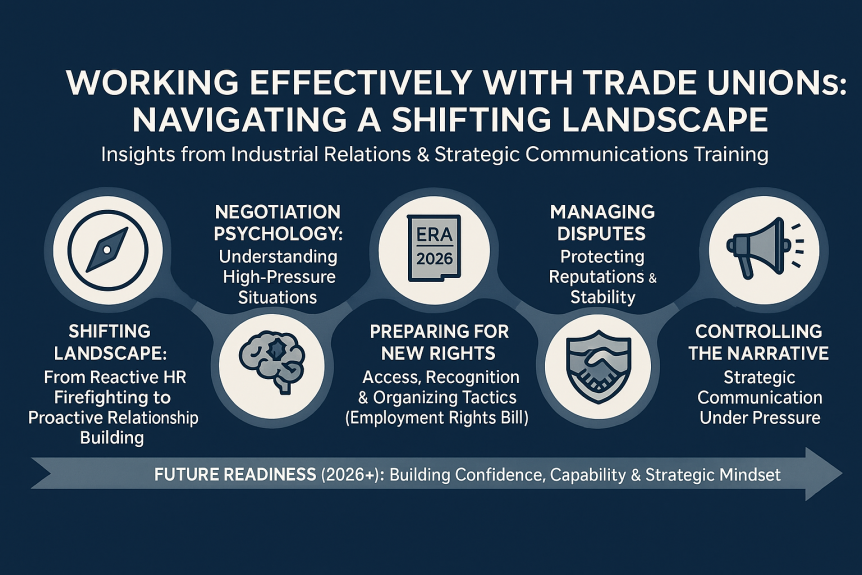
Insights from training: what HR teams are struggling with
In a recent training session I delivered with industrial relations specialist Brian Boyd, Head of Industrial Relations at NG Bailey, it was clear that many HR professionals are encountering negotiation and representation dynamics they’ve never seen before.
Common challenges included:
1. Moving from reactive HR firefighting to proactive engagement
Most organisations address issues only when a dispute emerges. Effective engagement requires relationship-building from day one — a principle long understood in public affairs, but forgetten in HR where an informal chat or coffee could head off many issues before they got started.
2. Managing the psychology of negotiation in tense, high-pressure environments
Modern disputes aren’t just about terms and conditions. They involve emotion, identity, leverage, narrative and timing.
3. Understanding the new obligations coming under the Employment Rights Act
The ERA will expand access rights, adjust recognition thresholds and introduce new information rights. HR teams will need a strategic grasp of what this means in practice.
4. Protecting organisational relationships, stability and reputation
Disputes now move across internal and external arenas. Decisions taken in a negotiation room can quickly become issues on social media, in local press or in stakeholder networks.
5. Maintaining control of your narrative when issues escalate across multiple fronts
This requires public affairs thinking — clarity of message, anticipation of counter-narratives, understanding audiences and managing reputational risk.
Why Public Affairs Training Is Becoming Essential for ER and HR Leaders
The overlap between industrial relations and public affairs has never been greater.
Modern organising often looks like a political campaign:
- alignment of actors
- coordinated advocacy
- strategic communications
- stakeholder mobilisation
- external pressure leveraged against internal decisions
This means HR teams increasingly need the same capabilities public affairs professionals use:
- stakeholder mapping
- scenario planning
- message discipline
- narrative control under pressure
- political awareness
- strategic influence and negotiation
- anticipation of external leverage points
Organisations that understand this shift will be far better prepared for the ERA and the more dynamic landscape emerging around it.
What This Means for Leaders Preparing for 2026
2026 is just round the corner.
The ERA will introduce legal obligations — but the wider environment will introduce strategic challenges. Organisations that invest now in employee relations capability, public affairs training, and strategic communications skills will have a significant advantage.
Leaders need to build expertise in:
- ERA-readiness
- modern union engagement strategies
- high-stakes negotiation
- public affairs capability building
- stakeholder management
- narrative and reputation management
- scenario-based crisis planning
This is no longer just an HR issue.
It is a leadership, communication and strategic-competence issue.
Support for organisations preparing for the ERA and the new workplace landscape
I work with organisations, agencies and public affairs teams to strengthen their capability through:
- Tailored employee relations training
- Public affairs training for consultants and in-house teams
- Scenario-based negotiation and influence workshops
- Strategic communications and narrative-control training
- Capability-building programmes
If your organisation is preparing for the changes coming with the Employment Rights Act 2026, or if your public affairs or HR teams need to build confidence in an increasingly coordinated and dynamic environment, I’m always happy to discuss bespoke training or leadership sessions.
2026 is just a month away — and the organisations that invest early will be far better positioned when the new landscape arrives.